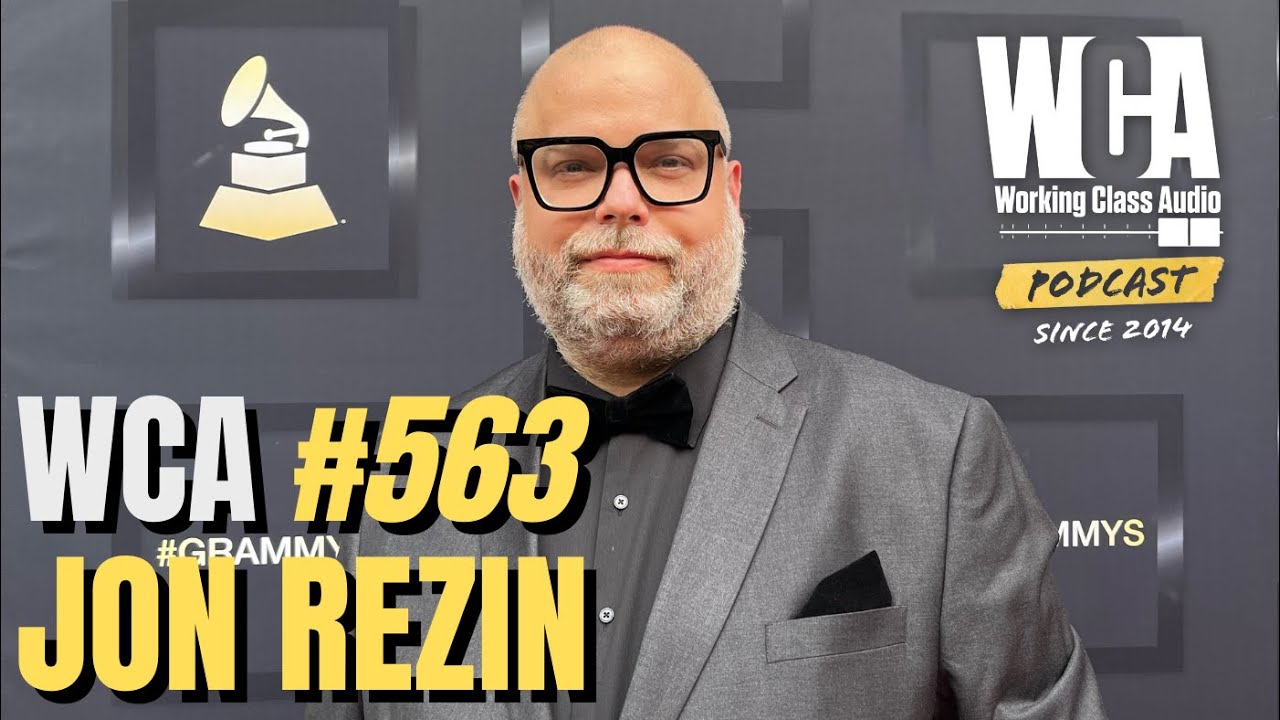
Saya duduk bareng Matt Boudreau di podcast lamanya Working Class Audio untuk membahas bagaimana karier sebenarnya dibangun — bukan dengan mengejar gig, tapi dengan membangun hubungan yang nyata; bukan dengan membakar uang sewa di LA, tapi dengan diam-diam pindah balik ke Ohio dan membuktikan bahwa pekerjaan tak peduli kode pos. Kami membahas American Idol, pindah ke barat, pulang ke timur, ngemix The Masked Singer, Grammy, AI, dan semua bagian berantakan di antaranya.
Kamu nggak pernah tahu hubungan mana yang sedang kamu bangun — atau yang gagal kamu bangun — yang justru bakal melontarkanmu ke level berikutnya.— Jon Rezin
Perbincangan
Matt: John, selamat datang di podcast.
Jon: Terima kasih sudah mengundang saya. Suatu kehormatan bisa di sini.
Matt: Senang bertemu denganmu. Mari mulai dengan yang biasa saya mulai — keadaan saat ini. Siapa kamu, kamu menganggap dirimu apa, kamu di mana, seperti apa keseharianmu, lalu kita gali masa lalumu.
Jon: Tentu. Saya Jon Rezin. Saya audio engineer — terutama mixing dan mastering. Saya juga melakukan produksi. Saya tinggal di Ohio. Saya di New York City selama sepuluh tahun, lalu di LA selama tujuh belas tahun, dan baru-baru ini kami pindah kembali ke Ohio. Orang tua semakin menua, jadi enak bisa dekat dengan mereka. Keseharian saya mixing rekaman — banyak klien indie dan major label. Cukup beragam: J-pop, kirim stems untuk Latin pop, banyak pop, banyak Afrobeats, yang sangat seru. Dan bersamaan dengan itu datang banyak proyek mastering.
Matt: Apakah banyak klienmu hasil dari masa-masamu di LA atau New York?
Jon: Klien saya tersebar di mana-mana. LA adalah tempat utama mereka berkembang — tempat peluang benar-benar mulai terjadi — tapi kebanyakan dari mereka bahkan sudah tidak di LA lagi. Tersebar di mana-mana.
Matt: How do people find you?
Jon: I have a website, but really it comes down to relationships and word of mouth. I'll work with somebody, and if they enjoy the experience — which I hope they do — they have friends who need help, or workmates, and they refer me. I'm blessed that most of the people I work with come back to do more projects and refer others. A lot of projects lead from one to another to another. It's really interesting to be able to trace the lineage.
Matt: Where did you grow up, and what was your involvement with music or technology growing up?
Jon: I grew up here in Ohio — about seven minutes from where I live now. My parents had a band, and I remember sitting on the stairs as a kid listening to them practice. By middle school they'd stopped playing, and all the instruments were in the closet. I rediscovered them, started playing guitar, and recording myself on this old reel-to-reel — just doing wild experiments. Then I went to a performing-arts high school in Columbus called Fort Hayes. I spent most of the day in the music program doing jazz. They had a small studio, and I used it to record demos for myself. I fell in love with the process. I had more discipline working in a studio than playing guitar eight hours a day. Trying to keep up with my peers as a player was maddening — but the studio stuff, I just couldn't get enough.
Matt: Where did you go for school in New York?
Jon: City College of New York, which I guess is a very prestigious school. My second or third year I was talking to a professor and called it a "community college." He was like, "This is not a community college. This is a very prestigious university." I was like, "I don't know — I'm a musician." We had 24-hour access to the studios while I was in class, so I'd bring clients in. I was working full-time in studios at the same time, so I'd come back to class with real-world questions: "I ran into this issue. How do I deal with that?" It became a really real-world learning process.
Matt: Once you graduated, what was the trajectory?
Jon: They graduated me — they were like, "It's time for you to go. You've been here too long." I did five years of a four-year program just because I wanted to keep using the studios. I had enough clients that it wasn't an issue. I had a small apartment in the Bronx and clients would come by — my apartment was set up as a studio. The upstairs neighbors, I'm sure, loved it. We worked there for a number of years until it was time to leave New York.
Matt: What was the cause of leaving?
Jon: I was there ten years. Amazing city — but the romance had worn off at about three. I was there about seven years longer than I was romantically involved with the city. Then I met who became my wife. She didn't like the cold. I was done with New York. So we ended up making our way to LA, bringing some of the clients I had virtually. There was kind of a big exodus of people moving out of New York at that time. I was near the beginning of that wave.
Mendarat di LA — dan pekerjaan yang mengubah segalanya
Jon: When we got to LA my wife had a fiancé visa but no work visa, so I was supporting us. I got a job at Westlake Pro, which sat above Westlake Studios — selling studio gear, but not a walk-in store. We'd go meet clients at their studios. I'd introduce myself as an engineer, not as a salesperson. People would have me come look at their setup, install gear, and then hire me to work on projects. It just built. After about six months — once I had enough clients — I quit.
Jon: Then someone I'd helped install a Pro Tools rig hit me up months later: "Do you know how to tune vocals?" I said sure. He said, "Okay, I'm going to have someone call you." A few minutes later I was driving and my phone rang. I pulled over. That was when I started working on American Idol. They said, "We're starting tomorrow morning at seven." I was one of three vocal engineers picked up to work with the talent for their studio albums. It's the luck of the draw — you never know which relationships are going to catapult you to the next level.
Itu membukakan pintu peluang yang besar. Saya kerja di American Idol kira-kira tujuh musim mengurus produksi vokal dan tuning, lalu memanfaatkannya untuk melompat ke gig-gig lain.— Jon Rezin
Jon: Another time work was slow, I went on Craigslist and saw someone needed a mix engineer. I responded to the post — that was Toby Gad, an A-list songwriter-producer (All of Me, If I Were a Boy). I ended up being his mix engineer for three or four years and working with an insane amount of people. That led to mixing a song he wrote with a big Japanese entourage that flew in to finish the record. Later one of those people said, "I need a mix engineer," and someone said, "Oh, you met Jon at the studio." That ended up being SM Entertainment, which is a major K-pop label that also does J-pop. It sounds like gloating, it just is what it is — like fifty number-one records in Japan and all over Asia. Just a ton of work. And it's all building relationships.
Matt: You really hit the ground, not necessarily running, but ramped up really quick.
Jon: My time in New York I really spent on developing skills — nose to the grindstone, work, do the best I can on every project regardless of budget. When I moved to LA I realized the part I hadn't been developing was network. I had skills but no work because no one knew me. So I started focusing on network — not in a transactional way, but in a "let's create relationships" way. There's been a lot of symbiotic relationships out of it. Changing my focus to building real relationships that last beyond a gig has been one of the significant things in my career. People are going to call the people they like first, or their friends' relationships.
Apa kamu punya strategi?
Matt: When working with people in LA, did you have a philosophy of how you behave, things you talk about, the things you don't, how you set the tone of the room? Were there conscious strategies?
Jon: So that would have been smart. That'll be my next phase. Like most audio engineers I'm very opinionated. I share my opinion. With clients I tell them upfront — "I'll do whatever you need because your name is on the record, not mine. But if you ever hear me say I'm happy to ruin your record for you, just know we've reached the point where I'm really disagreeing." I didn't have a conscious strategy. I tried not to offend people. There's an earnestness and sincerity mixed with sarcasm, and what some people would call know-it-all-ness but is really just confidence — and I'm happy to change my opinion as long as I get better information.
Yang paling mendekati strategi buat saya cuma rasa penasaran besar terhadap apa yang dikerjakan orang lain. Saya jarang banget cerita soal diri saya — saya terus bertanya sampai mereka yang nanya, saya kerja apa.— Jon Rezin
Jon: I heard a talk later that said if you show interest in somebody, that person is going to remember you as an interesting person. Listening more, talking less, asking questions constantly. I always hated networking events — "Hey what do you do? How can I make money off of you?" — I hated that. So I used that mindset shift to go to music conferences and just learn what people are doing, ask questions, develop real relationships. And it wasn't false interest. I'm actually interested in what makes people tick.
Mengapa kami pergi dari LA
Matt: What were the reasons you left Los Angeles?
Jon: We'd been there a long time and it was going great. Three kids, wife, living in Riverside. Then COVID hit — I have some underlying health conditions, so we locked down hard. We started examining: do we want to keep paying rent? No one ever came to my studio anyway — I'd shifted more to mixing, so people just emailed me stems. I was remote before it was a thing. The kids were homeschooled. The kids were like, "What's our next adventure?" We said a bunch of prayers about it. We looked at Japan. We looked at the Big Island of Hawaii — actually went out and spent a month near the University of Hawaii. Lovely, but it wasn't home for us.
Jon: At the same time my parents were starting to need help — phone calls about my mom being in the hospital. So we added Ohio to the list and kept praying about it. Every door to move back to Ohio opened. We moved back. We're working on community-outreach stuff here — particularly for children, junior youth and youth, since that's the ages my kids are. Got a house in the woods, a couple acres, twenty minutes from an international airport. Once we moved back, suddenly I'm getting phone calls and my mom — who'd been homebound for over a decade — is going out to the movies. I don't know if she just wanted me to move back, but she's happy I'm here.
Matt: Were there any concerns about career moving back?
Jon: There was a nagging thing. Most audio engineers — we work in an industry filled with rejection — so there's always this little voice: if I move back, have I failed? But I was working constantly. I'm lead mixer for the music-production side of The Masked Singer, doing a ton of J-pop. Right before we moved, one of the records I worked on won a Grammy. So that was a nice little parting gift from LA — like, "Hey, don't worry, you actually are decent at what you do."
Mixing The Masked Singer (dari Ohio)
Jon: Lineage is so fun. Remember those Japanese folks I mentioned? One of the songs I worked on was on a Japanese girls' record. I listened to the rest of the album and the other producer was incredible — his name's Ariza, based out of LA, Colombian. I just hit him up on Instagram: "Yo, you killed this." We got together. Everything he played me was unbelievable. We worked together for years. He had a friend hit him up looking for an engineer, and he referred me to Miguel Gandelman — the music director for The Masked Singer. The first project was just a one-off little song. Later, another engineer on the show needed someone to replace himself, and Miguel already knew me. We had a quick consult: "Do you want to do this?" "Yeah, let's go." I started as lead mixer for the team. Eventually the show itself was like, "We really like what you're doing — can you mix the show?" So now I'm doing the music production side and mixing the show.
Matt: Once people figured out you were in Ohio, clearly not a problem for them.
Jon: Apparently not. The pandemic — for as terrible as it was for a lot of reasons — kind of catapulted people forward at least a decade in remote collaboration. Ariza was like, "I don't want to do Zoom." I told him he had to. Now it's his primary way of collaborating with people all over the place. It's amazing to watch people embrace technology that would've felt foreign before.
Kalau pun saya harus terbang ke LA untuk alasan apa pun, biasanya untuk pameran dagang atau meeting. Tapi soal mixing dan mastering — udah nggak ada yang peduli kamu tinggal di mana.— Jon Rezin
Jon: I'd add the caveat that this is because I'm a mixer and a mastering engineer. If I were a producer it'd be much harder — there's so much in-person collaboration to create. Or as a musician — people would say "come to the studio" and you'd be far away. I do a lot of remote collaboration when I'm producing with people all over the world, but it's not as easy as it is for us mixers.
Harga, alat, dan waktu sebagai mata uang sesungguhnya
Matt: Pricing — now that you're in Ohio, do you feel you can be more competitive because expenses are lower? Or do you keep it level?
Jon: The way I charge is flat rate. It's never changed. That's the unique thing about building a personal brand — you're not a cog in a machine that can be replaced with another cog to do the same thing. There's always somebody cheaper, but if you love what I do, I'm the one who does what I do.
Matt: When it comes to gear — I'm assuming you have pretty much everything you need. Is it just plugin temptation now?
Jon: Mostly, yeah. I saw something a couple days ago that looks like 1176 guts inside a small black box with no controls — UA has a digital plugin to control it. That compressor I've always wanted in my rack. But it's not something I need. When I'm buying stuff these days, the question is: how is this going to save me time? I got the Noise Workshop Dynamo — basically a vocal-rider audio-suite plugin — that's been amazing. Just got Fast Bounce — an external app that opens sessions, prints stems however you tell it to, closes, opens the next one. Before you go to bed, hit go. It's stupid fast.
Sekarang ini, kalau saya beli barang, pertanyaannya: gimana ini bakal menghemat waktu saya?— Jon Rezin
Tentang manajemen, AI, dan pekerjaan yang masih menanti
Matt: Do you have a manager?
Jon: No, I am my manager — and I'd fire myself except then there'd be nobody left. I tried to get one. Most of the conversations went the same way: it's really hard right now, even people with big names are having trouble finding gigs at decent budgets. They didn't dismiss me — we had the conversation, they looked at the work — it just wasn't a good fit. Maybe at some point. What I'd really love is an agent seeking out gigs with specific artists I want to work with. There are a lot of legacy artists I'd love to do a record with. There was one — Oliver Mtukudzi, the legendary African artist. I really wanted to work with him. He died before I ever reached out. So how do you find the opportunity to do that? That's something I'm still working on.
Jon: The Masked Singer stuff has me listening to a lot of records — we have to match records so it sounds just like the original, good or bad. And I've heard records by amazing artists where the mixes are objectively terrible, but they're a vibe, right? So how do you engage in that conversation of, "Hey, I love you, and your last record sucked. Your mixes sucked. I can handle that for you."? You can't do a backhanded comment to somebody — like compliment and smack at the same time. So how do you position yourself? It's an interesting conversation. If you have any brilliant ideas, I'm all ears.
Matt: No, I certainly don't have the answers — especially when reaching out to artists. Some artists get sticker shock when you give them your rate. Like, "Whoa, I've got a guy in Uruguay who can do this for $75 a song." And you're like, okay.
Jon: Yeah. That's the reality of remote collaboration becoming possible — people can look everywhere to find the best talent within their budget range. I'm not inexpensive at all. I'm expensive — I know that. But that's where the personal brand really matters. There's always somebody cheaper, but if you love what I do, I'm the one who does what I do.
Matt: Exactly. Anyone who focuses on mixing will do a particular thing, and if you're into that, you're going to have to pay for it.
Jon: Yeah. I'm fortunate to be able to enjoy this journey. And until AI puts us all out of work, we keep going.
Matt: "Give me a mix in the spirit of Jon Rezin."
Jon: I want to find that, actually — so I can sit back. Spike Stent announced Spike AI, and the immediate reaction wasn't good job, it was wow, you too? But Jesse Ray Ernster had a really good take: it's just a tool. People use CLA plugins because his name's on it, and it saves them time. Your records aren't going to sound like Spike Stent's just because you ran his AI on them. Your creative taste is the thing. AI just becomes another tool in the arsenal — like all the 1176 clones, the LA-2A clones. We're already in the habit of using tools that emulate what someone is already doing. AI just adapts faster.
Jon: Building a personal brand, having great taste, and having people who are willing to pay for that taste — that's the key. Then you use whatever tools save you time.
Penutup
Matt: This has been fantastic to chat. I think we're in agreement on a lot of things. Thank you so much for making the time.
Jon: Thank you for reaching out and inviting me. You've got a lot of heavyweights on this show, man — you're really creating a great resource for people coming up in the industry. Congrats on that.
Dengarkan episode lengkapnya di YouTube atau di mana pun kamu mendengarkan podcast. Terima kasih banyak buat Matt Boudreau dan komunitas Working Class Audio.